
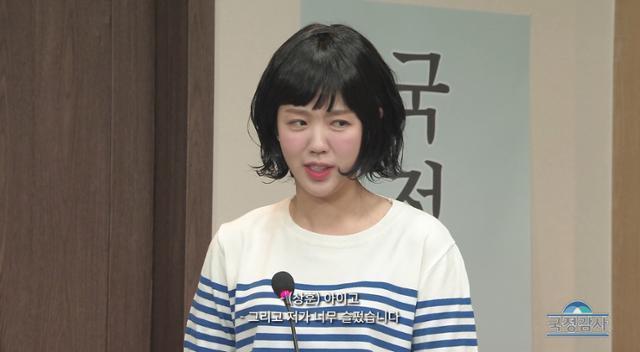
Actor Ji Yea-un mimics NewJeans member Hanni’s testimony in broken Korean during a National Assembly audit in an “SNL Korea” skit. Captured from Coupang Play
Recent controversies surrounding popular Korean comedy and entertainment programs have exposed a troubling trend: the exploitation of vulnerable individuals as comedic fodder, often masquerading as parody.
The streaming platform Coupang Play’s “SNL Korea” and the dating reality show “I Am Solo” on SBS Plus and ENA channels have come under particularly intense scrutiny.
This backlash has laid bare deep-seated issues within Korea’s entertainment industry, prompting calls for a major overhaul as these shows face mounting criticism for their insensitive portrayal of marginalized groups, both at home and abroad.
“SNL Korea” has repeatedly courted controversy with its inappropriate depictions of vulnerable individuals. In a recent “National Assembly Audit” skit aired on Oct. 19, actor Je Yea-un performed a sobbing, stammering imitation in broken Korean, saying, “I met an employee in the hallway and greeted them, but a supervisor from the adjacent team told me, ‘Hey, just ignore her.’ I was very sad.”
The skit was a clear reference to NewJeans member Hanni, a Vietnamese Australian, who had recently given emotional testimony about workplace harassment during a National Assembly hearing.
If a white American actor had mimicked an Asian immigrant struggling to express their pain in broken English on the U.S. version of SNL, it would likely have sparked outrage and accusations of racism. With growing awareness of human rights issues, Korean public opinion has reacted strongly, with many critics condemning the skit as “racist” for mocking Hanni’s speech.
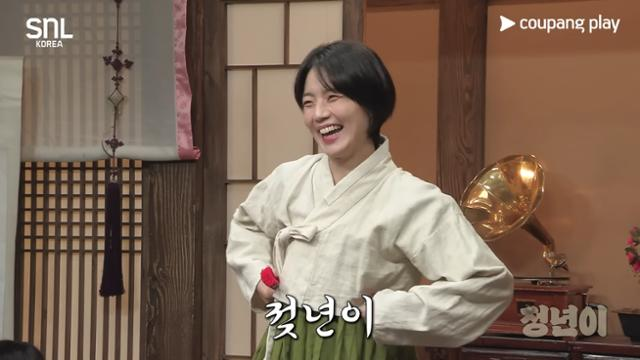
Comedian Ahn Young-mi parodies the drama “Jungnyeon” with exaggerated emphasis on a specific body part in an “SNL Korea” skit. Captured from Coupang Play
Failure to understand the essence of parody
Critics argue that a more thoughtful parody could have highlighted Hanni’s courage. Instead, the skit’s focus on her accented Korean served only to mock, rather than provoke meaningful reflection.
Cultural critic Kim Heon-sik observed, “Mocking the vulnerable isn’t parody—it’s inflicting further harm.” He added that the skit reflects deeply ingrained issues within Korean comedy.
Lee Ji-haeng from Dong-A University’s Gender and Affect Studies Institute echoed this sentiment, stating, “Effective parody should enable viewers to critically examine power structures. This skit utterly fails in that regard.”
Just a week later, “SNL Korea” ignited fresh controversy by parodying the popular period drama “Jeongnyeon: The Star Is Born.” The show, which features teenage female protagonists, was reduced to an offensive, hypersexualized caricature in the skit.
This recurring issue highlights the show’s fundamental misunderstanding of parody’s essence: to critique societal norms or those in power.
Such insensitivity isn’t limited to “SNL Korea.” In February, mukbang YouTuber Tzuyang faced backlash after featuring a Filipino woman in a culturally insensitive and racially charged comedy sketch. The video was eventually removed following outcry from Filipino netizens.

Mukbang YouTuber Tzuyang, right, features comedian Kim Ji-young imitating a Filipina marriage migrant in a video posted last January. Following criticism for racial insensitivity, the video was deleted. Captured from Tzuyang’s YouTube channel
‘Pseudo-parody’ prevails
This incident underscores the lack of content vetting systems on online platforms, a significant industry problem highlighted by Han Seok-hyun of YMCA’s Civic Center.
The rush to capitalize on trending “memes” and visuals often results in what critic Kim Gyo-seok terms “pseudo-parody.” He argues that these desperate attempts to cash in on popular culture without meaningful commentary lead to unfunny, harmful mockery masquerading as comedy.
Beyond content issues, the work environment for those creating these shows is also under fire. In September, the production company behind “I Am Solo” was fined after an investigation revealed writers were working without formal contracts, exposing the precarious status of freelancers in the Korean TV industry.
In another alarming case, six writers from a different show were summarily fired after reporting workplace violence. This power imbalance in the broadcasting industry leaves writers and lower-level staff vulnerable to exploitation and abuse.
“The controversies surrounding ‘SNL Korea’ and ‘I Am Solo’ signal a regression in Korean entertainment,” cultural critic Seong Sang-min noted. “Instead of scapegoating ‘political correctness’ for comedy’s decline, the industry must focus on modernizing production practices to meet contemporary standards.”
This article from the Hankook Ilbo, the sister publication of The Korea Times, is translated by a generative AI system and edited by The Korea Times.






Most Commented