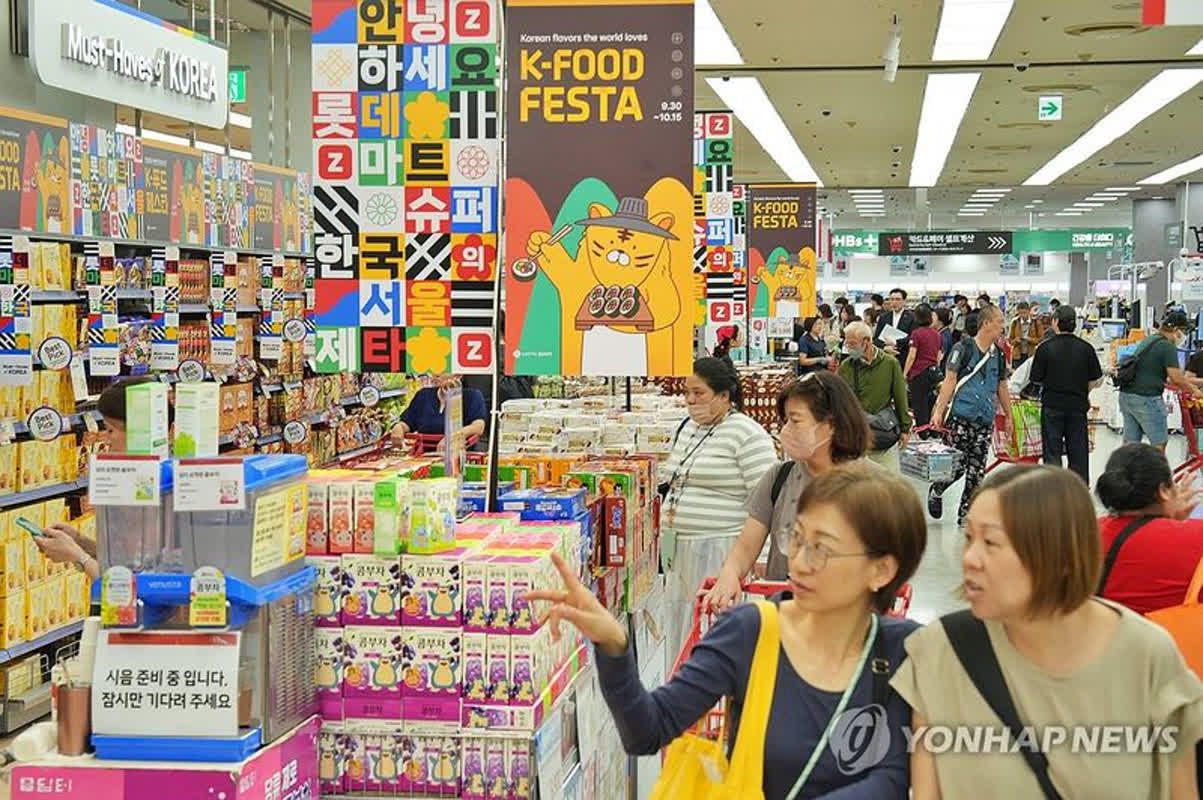
The ‘K-Food Festa’ is underway at stores specializing in products for foreigners.
Yonhap News
[Financial News] The government has discussed strategies to enter the halal market to further boost K-food exports.
This comes after a significant increase in K-food export figures to the Middle East during the first quarter of this year.
Halal food refers to products that are permissible for Muslims to eat and use according to Islamic law (Sharia).
The Ministry of Agriculture, Food and Rural Affairs held a meeting on expanding K-food exports, including halal food, on the 13th at the aT Center of the Korea Agro-Fisheries & Food Trade Corporation in Seoul, in collaboration with the Ministry of Economy and Finance. This meeting is a follow-up measure to the 2026 economic growth strategy announced in January of this year. It was organized to discuss support measures for K-food’s entry into promising markets, a key task among the 15 leading projects of the super-innovation economy, and to gather diverse opinions from agricultural and food export companies and related agencies.
The attending companies unanimously agreed that support for identifying promising products by region and market, as well as assistance for entering new markets, should be strengthened, particularly in the halal market. They also suggested that promotions linked to content are necessary, as K-food is often enjoyed alongside media content. Additionally, they recommended expanding support to overcome halal certification and logistics-related constraints applicable to raw materials and processed foods, given the unique nature of the halal market.
Min Kyung-seol, head of the Innovation Growth Office at the Ministry of Economy and Finance, stated that the government would enhance support to quickly resolve difficulties in the export process through a ‘one-stop K-food export support hub’ involving multiple ministries and related agencies. The export support hub is an online and offline service that connects public and private experts to address issues throughout the entire K-food export process, including customs, clearance, foreign exchange, and certification.
In particular, the government plans to actively support companies’ overseas market entries through the ‘Global Next-Generation K-Food Development Project.’ They plan to expand practical policy measures that can assist companies, such as an online K-halal food hall, export vouchers for agricultural products, and support for intellectual property applications and registrations, with the Ministry of Agriculture and Food at the center of these efforts. This project aims to proactively identify next-generation export-promising products that reflect global consumer trends and technological and industrial changes.
Jung Kyung-seok, Director of Food Industry Policy at the Ministry of Agriculture and Food, stated, “Despite the conflict in the Middle East, we plan to alleviate the burden of overseas certification for companies through the Overseas Food Certification Support Center, strengthen logistics support such as shared warehouse usage, and continue to support mid- to long-term research and development of halal materials and preservation technologies, as well as the exchange of specialized personnel, to target promising markets including the Middle East.”
Meanwhile, K-food exports reached $10.4 billion last year, marking a 4.3% increase from the previous year and achieving record-high performance. In the first quarter of this year, exports amounted to $2.56 billion, an increase of 4.0% compared to the same period last year. The regions with the largest increases were the Middle East (GCC, 32.3%), the Greater China region (14.5%), and North America (6.3%). The Middle East recorded $106.9 million in the first quarter. In January and February, exports of tobacco products totaled $72.1 million (up 77.0%), and ginseng products reached $500,000 (up 814.3%), both showing strong performance.
junjun@fnnews.com Reporter Choi Yong-jun